







Mongolia has some of the harshest winters in the world. Ulaanbaatar is the coldest capital in the world. In January the average is around -20 to -25 degrees, and the coldest nights approach -40. Out on the steppe there is no shelter.
Even so, nomadic families live outdoors with their animals all year round. It is the animals' wool that makes it possible.
Two kinds of hair
A Mongolian cashmere goat has two layers. On the outside are the long, coarse guard hairs, which take the wind and snow. Underneath is the undercoat, a dense layer of very fine, crimped fibres that holds in the warmth. It is the undercoat that becomes cashmere.
The yak and the two-humped camel are built the same way. Both shed their undercoat in spring, the camel in large tufts.
Daylight sets it going
It is not the cold alone that makes the undercoat grow. Research on cashmere goats shows that it is day length. When the days grow shorter after midsummer, the hair follicles begin to produce undercoat, and it grows through autumn and winter. When the days grow long again, it stops, and in spring the animal sheds it on its own.
The cold decides how much the animals need it. The goats on the steppe have lived with these winters for generations.
Why Mongolian cashmere is different
Mongolian cashmere is not finer than cashmere from China. Chinese cashmere is in fact slightly thinner. The difference lies elsewhere. A study of Mongolian goat breeds found an average fibre length of 44.9 mm and a crimp of 61.9 degrees per mm. By comparison, cashmere from China is around 46 degrees per mm. The researchers also found clear differences between cashmere from local Mongolian goats that roam freely on the steppe in a harsh continental climate and cashmere from goats in intensive farming.
Longer, more crimped fibres make a stronger yarn. That means knitwear that keeps its shape better and pills less. The average for Mongolian cashmere is around 16 microns, which is first grade.
Gathered in spring
When the animals begin to shed, usually in March and April depending on the region, the undercoat is combed out by hand. The guard hairs stay, because the animals need them for the rest of the year. A goat gives around 150–250 grams of raw undercoat a year. After cleaning there is less left, and it takes wool from several goats to make one sweater.
A yak gives 300–700 grams of undercoat a year, a camel several kilos. That is why yak wool and camel wool cost less than cashmere.
When winter is too hard
Mongolians have a word for the winters when things go wrong: dzud. It happens when a dry summer leaves too little fodder and the winter then covers the grass with snow and ice, so the animals cannot reach it. In the winter of 2023–24 around 4.7 million animals died. It was the sixth dzud in ten years.
For nomadic families a dzud means losing what they live on. Many move to Ulaanbaatar afterwards. It is part of the story behind every sweater, and one of the reasons we want to know more about where our producers buy their wool.
At home with you
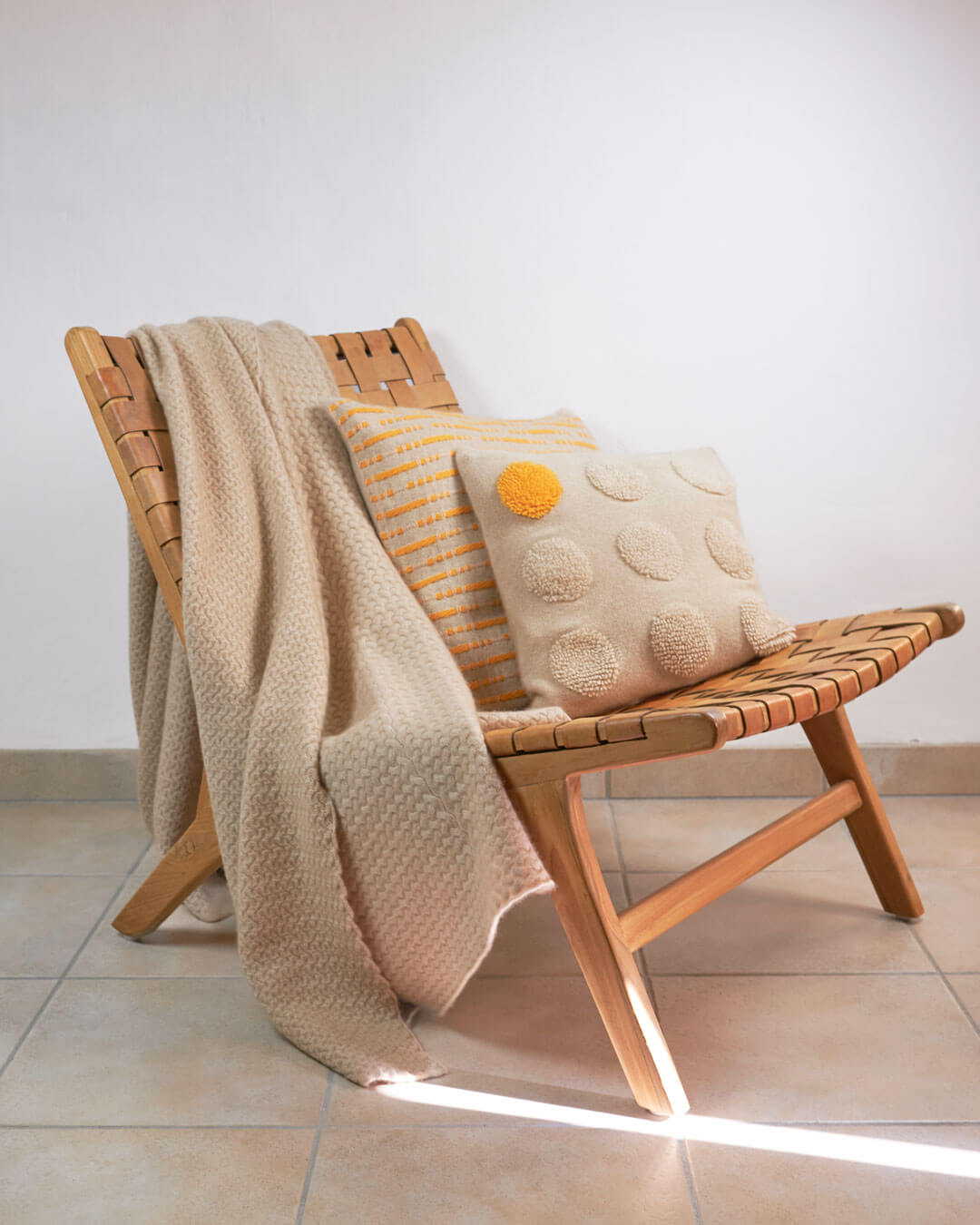
The same wool that keeps a goat alive at -30 degrees is what you wrap around you on a cold November evening. It keeps you warm because it holds the air, and it breathes, so it is comfortable to have around you all evening.
See yak wool throws · See yarn · Read more about cashmere, yak and camel wool
