




Repair
A hole in a good sweater isn't the end
When a piece of fine wool is worn year after year, a small hole can eventually appear — from moths, from a bag that's rubbed a little too much in one spot, or from a day in the thorn thicket with the dog. That's part of keeping something for a long time. It's rarely a reason to throw the sweater away.
In most cases a hole can be darned without it becoming visible. And if it's large, or you're fine with the repair being visible — "visible mending" — it can still be fixed in a sensible way.
How to darn a small hole yourself
For holes up to about 5 mm, you can do the work yourself. You'll need:
- A thin darning needle with a large eye
- A length of yarn in the same quality and colour as the garment — ideally the repair yarn we include when we ship, otherwise from a yarn shop that carries cashmere or other fine wool yarns. You're also welcome to get in touch with us to ask whether we have leftovers of the relevant yarn.
- A small piece of card or a darning egg to place under the hole
Method:
- Turn the garment inside out and lay it on a table.
- Place the card under the hole, so you have a flat surface.
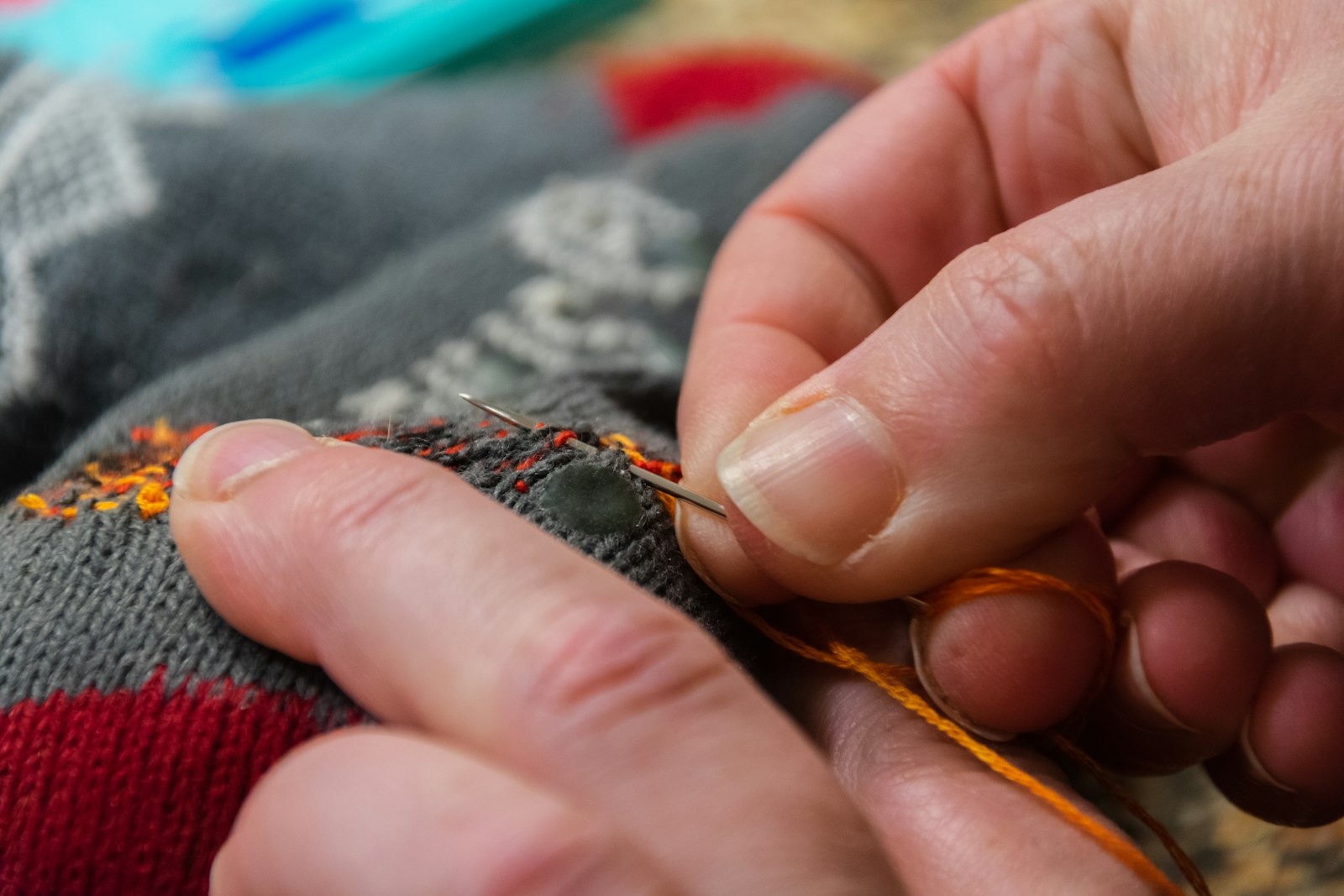
- Thread the needle and start about 1 cm from the edge of the hole. Sew small vertical stitches across the hole, parallel and close together.
- Now turn the needle 90 degrees and make horizontal stitches across the vertical ones. This weaves a small patch into the hole.
- Finish with a knot on the inside and trim the ends short.
The result is a small, firm weave that closes the hole and stops it from growing. With matching yarn, it becomes almost invisible.
For moth holes: freeze the garment for a day first (in a sealed bag), so the larvae are killed before you sew.
Visible mending — a different approach
In recent years, visible mending has emerged as a deliberate aesthetic choice, particularly inspired by Japanese craft traditions such as sashiko (geometric stitching) and boro (patched textiles). The idea is simple: instead of hiding the repair, you make it part of the garment's expression.
A visibly darned hole can be a contrast-coloured weave, a small embroidered motif on top, or a simple row of stitches that follows the knit's structure.
It's an attitude toward clothing we sympathise with: things become more beautiful from being used, and signs of wear aren't something you need to hide.
If you'd prefer professional help
For larger holes, or if you'd like a completely invisible result, we recommend sending the garment to a specialised tailor. In greater Copenhagen, several Danish craftspeople work with fine knitwear repair:
- Sart Strik — has experience with cashmere and fine merino, and places emphasis on making the patches as invisible as possible.
- HulHul — specialises in re-knitting holes in knitwear; prices start at 250 kr per hole and 150 kr for hand-woven patches.
- FRB Skrædder & Rens (Frederiksberg) — hand repair of cashmere and knitwear using the "invisible mending" technique.
Write or call ahead, and consider showing the garment before you decide — the price depends on the size and location of the hole.
Our ambition
We're working toward being able to offer repairs through our producers in Mongolia — especially for our own clothing, where we have access to the original yarn. It's not in place yet, but it's a direction we believe in: that part of selling clothing meant to last a long time is helping it "through life", not just through the purchase.
Until then: write to us if you're unsure about a repair. We and our suppliers know the garments and can often help find the right solution — including when it comes to judging whether something can be saved or not.
Also read: The three fibres · Care and washing · Back to the main page
